
The Risk Engine.
Profile, history and observations. Connected over time to understand what changes for each animal.
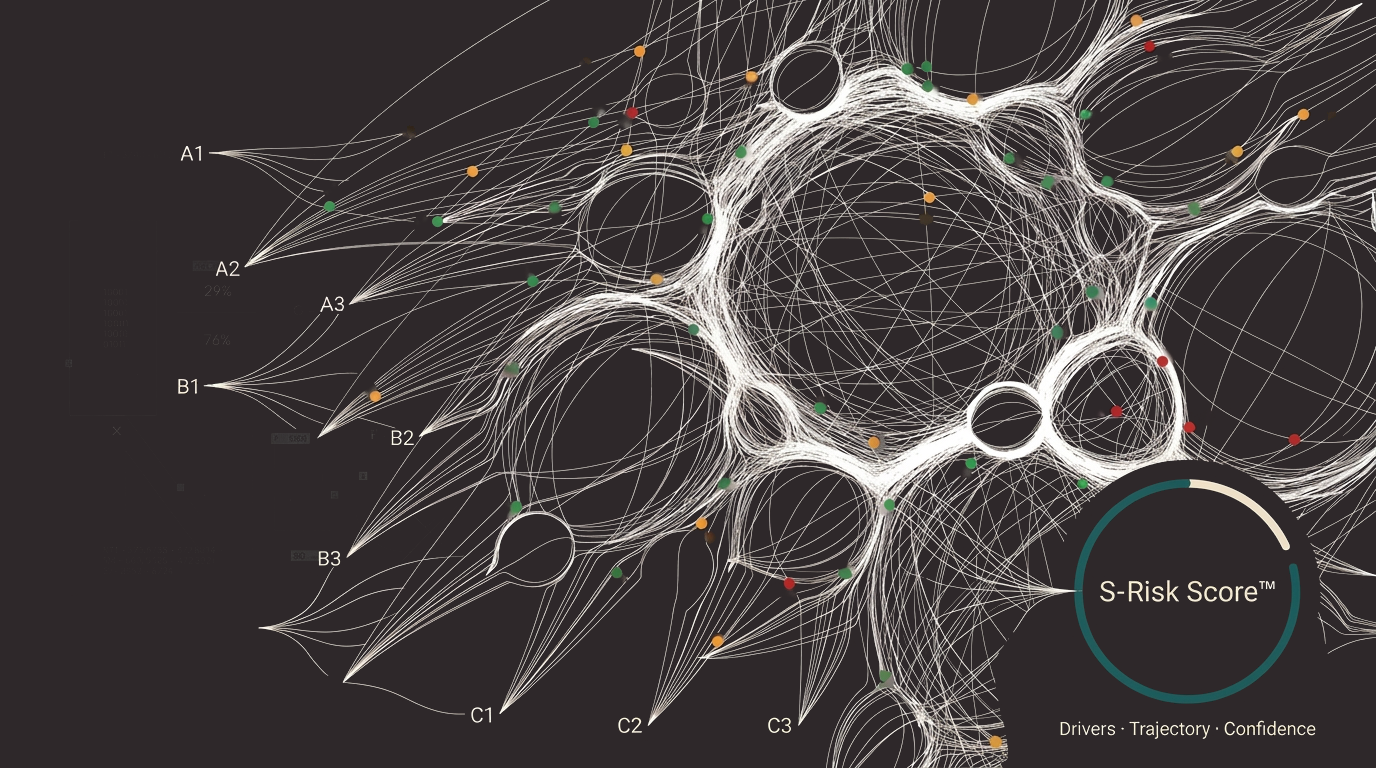
The Risk Engine establishes an individual baseline, assesses meaningful change and evaluates its significance. The result: the S-Risk Score™, with drivers, trajectory and confidence.
The assessment depends on the quality and extent of the information available.
S-Risk Score™
Individual baseline · Canine
Elevated
0.89
180 days
Today
The platform’s structured risk assessment.
The S-Risk Score™ expresses an animal’s changing risk state. Supporting drivers, trajectory and confidence help partners interpret it. A suggested next-step category can follow where the context supports it.
The Risk Engine powers the assessment behind Sanusian. Its methodology, data architecture, calibration and validation turn suitable observations, telemetry and records into structured risk intelligence. The Score assesses changing risk; it does not diagnose a condition or prescribe treatment.
Risk Passport™ carries the authorized baseline, observations and history that give the assessment longitudinal context.
Assess the significance of change, not just its presence.
Individual before population
Available profile, history and repeated observations establish what is normal for the individual animal.
Significance over noise
Evaluate magnitude, persistence, combinations of signals and trajectory where the available data supports them.
Explainability with the output
Use contributing changes, trajectory and confidence to interpret the risk state within your own workflow.
Guidance after the Score
Sanusian suggests the relevant next step from the risk state and context. The business makes the decision.
One continuous assessment pathway.
Every suitable observation travels the same path through the engine. Fragmented inputs become a comparable signal, the signal is read against the individual baseline, and only change that carries significance reaches the Score. The pathway runs continuously, so each new observation is assessed against everything the engine already knows about that animal.
- 01
Ingest
Fragmented inputsObservations, telemetry, records and profile information arrive from connected sources, in their native formats.
- 02
Normalise
Comparable signalsInputs are unified into a common signal vocabulary so different sources become comparable over time.
- 03
Baseline
Individual baselineAn individual reference model establishes what is normal for this animal, not the population average.
- 04
Detect
Change candidatesDeviations from the baseline are tracked continuously across time windows, as data allows.
- 05
Evaluate
SignificanceMagnitude, persistence, signal combinations and trajectory separate meaningful change from noise.
- 06
Score
Structured outputThe S-Risk Score™ is produced with drivers, trajectory and confidence, ready for partner workflows.
What the Risk Engine brings together.
The platform’s analytical core interprets available observations against individual context, longitudinal change and significance.
Personal baseline modelling
Establish what is normal for an individual animal.
Longitudinal change detection
Identify meaningful deviations and patterns over time.
Multi-signal fusion
Combine behavioural, physiological, observational and contextual information.
Significance
Evaluate magnitude, persistence, combination, trajectory and context.
Contextual calibration
Adjust interpretation to species, breed, available data and evidence.
Validation
Develop and test the methodology with veterinary expertise and suitable real-world evidence.
Connect risk assessment with your business workflow.
Explore how the Sanusian platform could fit your products and services.
Agree the available capabilities, data requirements and evidence for your use case.